








There is a lot of talk about Artificial Intelligence through the lens of generative magic or deceptive ease, obscuring a reality highlighted by a recent MIT study: 95% of corporate pilot projects never manage to generate real value—MIT: The GenAI Divide, 2025. But when we cut through the media hype to focus on day-to-day practice within an architecture firm like Arte Charpentier, we see a phenomenon far deeper than simply adding a new layer of technology to our existing tools.
What we are experiencing is not just the arrival of yet another software tool. It is a paradigm shift.
For decades, the unspoken agreement between humans and machines was clear: it was up to humans to learn the language of machines. We had to conform to the rigid logic of software, memorizing menus and defined processes. Today, we are witnessing a dramatic reversal of this logic: for the first time, it is the tool that adapts to our language, our context, and our immediate needs.
This reversal is manifested in the three major transformations it brings about in our profession.
From “Just in Case” Learning to “Just-in-Time” Learning
The first barrier to fall is that of technical complexity. Previously, a young architect had to spend weeks training on complex software, often learning features they might never use—“just in case.”
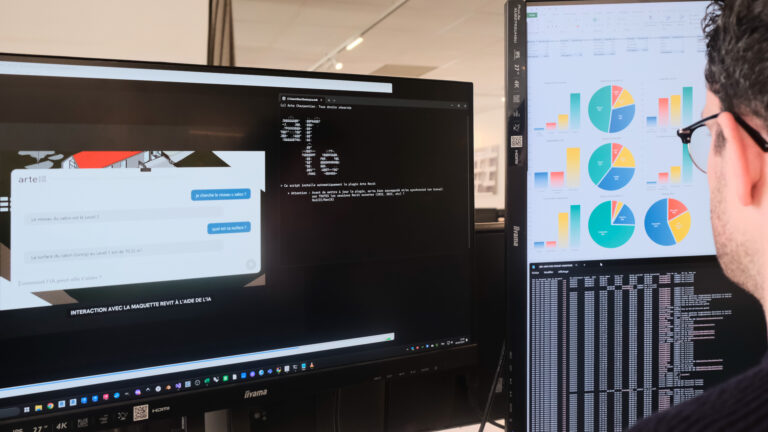
With conversational AI and immediate technical assistance, the learning curve is changing radically. Users can now interact with technical documentation. They ask a question in natural language (“How do I design a curved facade with these constraints?”) and receive a tailored response.
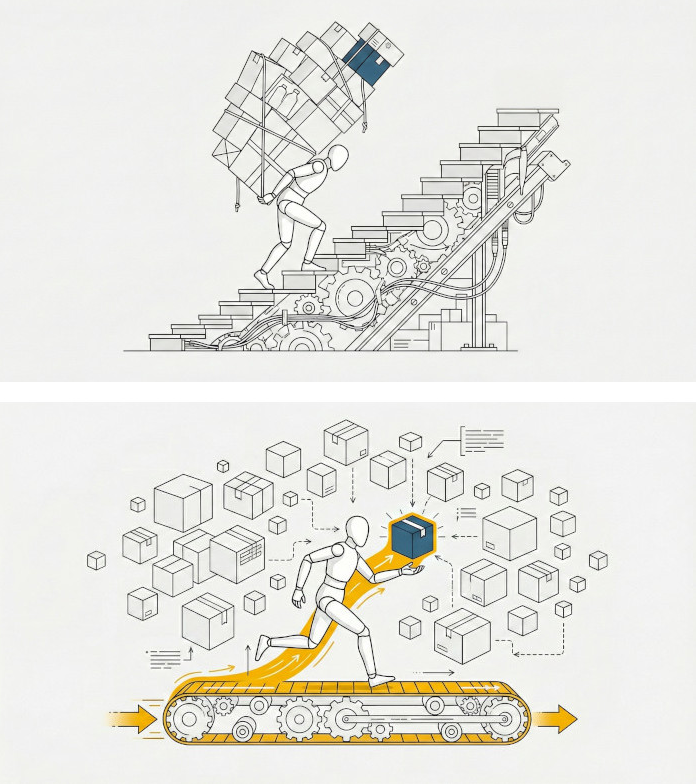
This doesn’t mean the end of expertise—quite the opposite. It turns frustration into a driving force. The designer becomes operational almost instantly on simple tasks. When they hit a “wall” or encounter a complex situation, it’s no longer a failure, but a catalyst for delving deeper into the fundamentals. We now learn out of necessity and curiosity, “just in time,” which makes skill acquisition much more deeply ingrained and sustainable.
The liberation from tools: the end of software dependency
This is perhaps the most strategic point for a company like Arte Charpentier. Until now, we were often held back by the limitations of our standard software (Revit, office suites, etc.). If a feature was missing, we had two choices: wait for an update from the publisher or buy an expensive and often over-engineered plugin. AI gives us back that choice. It allows our teams to become architects of their own digital environment.
Where developing in-house tools used to be time-consuming, AI now acts as a major productivity driver for technical professionals. It allows us to design and deploy, in just a few days, automation solutions with a high return on investment that would previously have required weeks of development.
We are transitioning from being mere users to becoming creators of our own tools. This allows us to:
- Create custom solutions that fully meet our specific needs.
- Better evaluate off-the-shelf solutions (the “Make or Buy” decision) because we have a deeper understanding of the underlying technical complexity.
- No longer have to put up with the “gaps” in our business software.
Toward a “Data-Centric” Organization: The Shared Brain
This technical mastery leads us to the ultimate challenge: unlocking the power of data.
The traditional business model consists of application silos: customer data is in a CRM, financial data in an ERP, and project data in yet another tool. Our knowledge is fragmented, and we are mere tenants of our own information, forced to rely on third-party interfaces to access it. AI and the ability to create our own connectors (our own “agents”) allow us to envision an architecture where data once again takes center stage.
The goal is to move toward a single “source of truth.” Instead of creating multiple applications, we can design customized interfaces for each business unit, all of which draw from this shared database.
- The architect checks a material’s carbon footprint in real time.
- The project manager sees budget alerts instantly.
- Management oversees the agency’s overall performance.
At Arte Charpentier, we don’t see AI as an end in itself, but as a powerful tool for autonomy. It doesn’t replace the architect; it eliminates the friction between their idea and its realization.
By shifting from being constrained by tools to mastering data, we’re not just “going digital”: we’re reclaiming time and power for what truly matters—our creativity and our professional expertise.
-

Francis Baucher Architecture
Responsable digital et IA
FORMATION
Architecte HMONP – ENSA Paris (2019)
Diplôme d’Etat d’Architecte – ENSA Paris (2018)PUBLICATIONS
Arte IA – Les Chroniques – Innovation et adaptation technologiques (2025)
Batiweb – Que pensent les architectes de la transition numérique ? (2024)
Arte IA – Les Chroniques – Architectes ou algo’ : qui façonnent l’avenir ? (2024)
Laboratoire EVCAU – Travaux R&D sur la réalité virtuelle/augmentée et la photogrammétrie appliquées aux domaines de l’architecture (2017/2018)CONFERENCES
Alumni – Parcours d’architecte en tant que BIM & Digital coordinateur (2024)
Erasmus+ « Patrimoines – Paysages – Perspectives » – Les nouvelles technologies comme moyens de conception architecturale (2015/2016)PRIX
3ème prix – Algeco – Agro’Cité : Un lieu unique d’agriculture urbaine (2021)